Saturday, 2 November 2013

Skills Week | Mask Making Paper


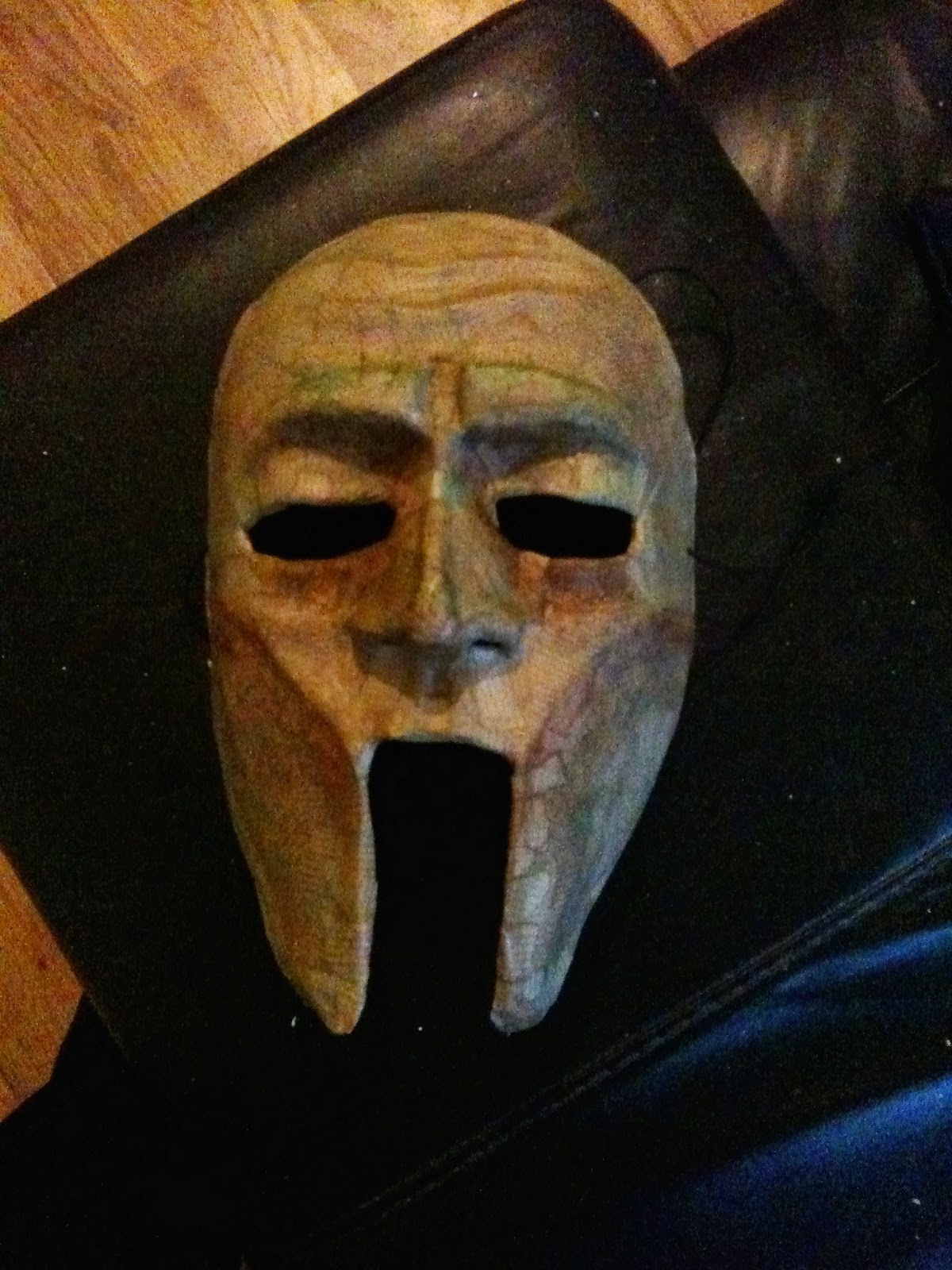
The second type of mask making that we did this week was to make a mask using clay and paper. 
We started this project of by being given two words. My words were 'Weary' and 'Sentinel'. 

After this we then we given a basic mould of a face and asked to build on top of it. Using clay we built up a basic shape. I chose to go with a very uniformed and strong shaped face to connect to the sentinel, guard sort of idea. 

Building onto of the face we worked into the clay and created strong lines and forms across the face. Once the mask was complete, to the way in which we want then we covered the mask in vasiline so that the plaster we put over the mask wouldn't stick or ruin the shape. 


Before creating the plaster mould we made a clay barrier so that the plaster wouldn't slip everywhere. Mixing part water and part plaster (enough so that the plaster powder peaks just above to water line). Then mixing them together to create a thicker, dense liquid. We drip the plaster over the mould, making sure we get into the eye sockets, even blowing air into the harder to reach areas and getting out the air bubbles. Once the finer details like the nose, eyes and mouth are all sorted we then drip more of the mixture over the entire face and layer it up to create a solid bowl like structure. Once there are enough layers, using a flat spatula or blunt bread knife create a flat surface, making sure to be careful enough to not catch the clay underneath the wet plaster. The flat surface is for later when the solid plaster will turn upside down, and sit stable on the table. 

Once the plaster has dried over night we then carefully remove the clay and we are then left with the negative mould of the mask. Clean out the clay that has stayed in the plaster mould with water and then cover the inside with more Vaseline. This is for the paper that we then layer up in the negative mould. Starting with the nose, as this is the hardest place to get to, then working on out to the sides of the face. Making sure everything is covered in brown paper and glue, let this dry. 

Once the brown paper and glue are dried, tare pieces of blue cloth and repeat the paper mashe technique, creating another layer. When paper mashe-ing, with the brown paper and blue cloth, it is important to cross over the pieces, this makes for a stronger structure. 

For the final layer, another layer of brown paper finishes the structure. Because the layers will still be wet, especially the nose, we then used a hair drier to allow the paper mashe structures pull away from the plaster. 


Fortunately I didn't have any problems with my mask pulling cleanly away from the plaster structure. However some others in the class had a problem with the nose not being fully dry and unfortunately not staying in shape because it hadn't fully dried. To fix this they used more brown paper to strengthen it or in some other cases just placing it back into the mould and leaving it to dry more. The mould helps to keep the shape of the mask and so this is the best thing to do if the mask isn't fully dried. 


To finish off the mask we measure the best place to punch holes into the side of the masks for the elastic to go through. by doing this we worked together and placing the mask on whilst another person lines up the eye holes with the top of the wearer's ears, then measuring in 1cm from the side to punch the holes. 

Tuesday, 22 October 2013

Site in the City Installation


The past week we have been really focusing down on the Site in the City project. 

Talking a walk around the city I came across the Castle in Nottingham. I hadn't visited it before and when I was walking outside along the wall, there was somebody practising singing inside, (maybe for a performance or something). This reminded me about the scene in the story of Cinderella and Ash Puttel. With this I then decided to look at the scene in the story where the protagonist is given something special, ie - Cinderella, where the Fairy Godmother gives Cinders a dress, a coach and coach men. I then began to look at what we, as 20 year olds remember about the story, and the magic scene was what was most mentioned. 

I then decided to look at what we actually remember. As well as what kind of objects or imagery we associate with memories or stories.

This then lead me to picking up a pumpkin, ivy vines and choosing to place it outside the castle. However with Halloween just round the corner, I thought this will just remind people Halloween is drawing in. So my next thought was to come up with a way in which to make people think a but harder about what a pumpkin and vines, placed by a castle is actually there for. 
To do this I decided to create a 'RESERVED' sign, as in it was reserved for Cinderella by her Fairy Godmother. 

I also added a bit of glitter to the piece to make it more interesting, and make people ask a few more  questions. 


The first place I had originally chosen proved to be ineffective. This was quickly learnt as I realised people didn't walk round the entire way, they seemed to stay one side of the area more. This then meant I moved the piece over to under a tree in a open space. 

Here the pumpkin gained a lot of views and some people taking photo's with it?
Not sure why. 
Asking people who had spotted it and had gone in to take a closer look, I asked what they thought it was here for, what it might mean and what it reminds them off. 
Out of the number of people I asked about 7 of them understood it completely, but were unsure as to whether it was what it was therefore. The uncertainty was gone however when I explained my idea to them. another 3 people didn't connect to it completely but as soon as I confirmed or explained they then understood and retold the story to me to make sure they were right. There was only one person who did not connect to it at all and it turns out they had never seen the Disney film, read the story or a stage production.

Over all I think it worked out fairly well, it has also given me more confidence about my own work and I feel more confident in myself and my work to do it again or try out new ideas. 


Friday, 18 October 2013

Charlie Peace and Bamboozle.

Ritual:
Bamboozle
·  Healing
           - Relaxing
           - Drums
           - Helper
           - Initiates - Not directly involved

    ^ Shamanistic like experience
           - Sensory Stimulus
- Water
- Meditating
- Pure / Honest
( Not conventional western medicine)


In Bamboozle the children were introduced to new objects, a new object was only introduced by music and the sound of the drums. (Which was muted, this made it less introducing and harsh.)

Water was used as cleansing in bamboozle, to entre the dream. This gave the sense of  a clean start to a story.


Performance/ Audience Relationship:
Bamboozle
· Music used to connect to the kids
· Pillows; hugging/ blankets as a sense of comfort and familiarity
· Performer being alive to the moment, reacting to the kids, seeing if they want to be hugged by the pillow, if they accept it. If not to performer moved over to the carer to show the children that it was ok and safe.
- Teaching new techniques to the carers to use later.
· Only trying to connect with one person, their eye contact
· Before the performance, the performers engaged with the children, learnt their names and introduced themselves to the children to create a relationship with them.

Charlie Peace
· Broke the fourth wall by entering the audience and interacting with them
· The genre of the play was based around the 19th Century tales
- Music Hall
- Mellow Drama

Object and Design:
Bamboozle
· Pastel/ Natural colours
· Simple and beautiful set
·  - Don’t think they quite explored the set, the items and it’s movement.
· Anthropomorphism
· Dream like, soft items
· Shadows
· Intermit

Charlie Peace
· Not well incorporated in the space
- Projection was very illustrative
- Actors were not always lit properly
- The circle moulds on the roof were moulded into the set, se when other projections were used, it didn't fit properly

Time and Space:
Bamboozle
· Look through the child’s eye’s
           - Creating their world
· Journey of ritual welcoming engagement of pillows (in character), the sling (the character), of lightness and the bird object which was developed through movement of flight.
· Dramatic structure rather than narrative
· Like a den for children
· Kids were allowed to think differently in the space
· Closed and intermit
· Patient atmosphere
· Took us into the world of the audience

Charlie Peace
· Confusing time era
· Costumes weren’t helpful in passing across the idea of time and age


Image, Light and Sound:
Bamboozle
· Gong—introduced to the kids to relevance the sounds
· Calming and soothing music
· Kids were fascinated with objects and there shadows
· Feathers and lateens
· Sign language was used when ‘thank you’ was repeated
· Simple structure

Charlie Peace
· Dim lighting
· Sometimes, depending on where the actors were on set, they were not properly lit
· Projection


Narrative and Structure:
Bamboozle
· In the Round
· Entre the dream —  In the dream —  Wake up from the dream
· Floating and flying types of feelings

Charlie Peace
· A non– chronological series of events


Saturday, 12 October 2013

Giles Croft and Micheal Eaton: Charlie Peace

I had never heard of a Charlie Peace, never knew anything about the famous criminal so to be perfectly honest, when I first walked into the auditorium and saw the set I was slightly confused. The flats which were on the side of the stage however gave a bit of information about Charlie Peace. For me I found them useful because it actually meant that I got a better beginning understanding about what I was going to watch.


I struggled to follow along, I got completely lost in the time era, the costumes and to be really honest, the set. I didn't understand the set, it was sort of like a mini stage on the actual stage. The audience could see the cast moving props and tables about on stage. The curtain was a bit of a problem, because I was sat in the middle of the auditorium on the ground floor I was able to see actors moving around behind it. This wasn't a big problem but it was something I couldn't help but notice. 

So the master class was actually really really useful for me. Being able to listen to the director's and the writer's thoughts and feelings towards the play was inspirational as to how passionate the writer was about the character Charlie Peace. Listening to the writers thoughts behind the play and how he researched the history of Charlie Peace and the idea behind the 'Travelling Show'. 

After listening and asking questions to the writer and director I got a better understanding of how they tried to approach the style of the show. The set was designed around the idea of a travelling show. Using a moving stage, taken around to fairs and circus' to put on a show. The Idea involves a rough, old look which looking back at the play I think was visible. I think the only problem was the costumes. They were too pristine to connect to the idea of the travelling show, they should have been more weathered down to link in more, following on with the idea that it's travelling and well used costumes. 

The master class really helped me with understanding the show and the idea around it, making more sense to me than when I had just watched the show.


Traditional Jewellery.

For Prince Amir it is easy to think of luxury whilst reading the story. Another reason as to why I think of jewellery is because Price Amir is being pressured by his mother to find somebody to marry. 

This is stated when Princess Zehra says to Amir: 


Turquoise stone : Energies : Luck, Love, Protection and Healing.

Ruby Stone: Energies: Love and Healing.

Emerald: Energies: Love, Prosperity and Healing.

Sapphire: Energies: Power, Love and Healing.

( http://crystal-cure.com/ for the stone colour energies.)

I have researched into jewellery that is traditionally worn at Indian weddings and my research has shown me the style which is worn. 

Golds metal is often worn with jowls of a certain colour. 
Rich colour such as the ones mention above are often used. The colours are rich and the jewellery can be very extravagant. 

I looked into a few different websites to look for extravagant jewellery which I could use for Price Amir's item. 

I have decided to use a ring as the symbolism I wish to use to explain Prince Amir. 
The reason for the ring, is to link in with what is expected of him, his mother wishes for him to find a bride, so she throws a Ball in which all the eligible girls are invited. At the beginning this ring appears to much as Amir isn't comfortable with himself or the land in which he lives. I don't feel that at the beginning of the story he is ready for marriage and seems to immature. However towards the end, once the Ball has finished and he has danced and fallen in love with this mysterious girl does he face his problems, over come he Sins that to process him he then commit to Ash girl and the ring becomes something that relates to him more.

Thursday, 10 October 2013

Themes and Imagery of fairytales

Carol Ann  Duffy - Collected Grimm Tales
Philip Pullman - Grimm Tales for Young and Old

Little Red Riding Hood - by Philip Pullman.
Imagery:

  • A little girl who was so sweet and kind, that everyone loved her.
  • A little cap made of red velvet.
  • 3 big oak trees, and there's her house, behind a hedge of hazel bushes.
  • Sun beams dancing
  • Began to snip open the wolf's bulging belly.
  • Oh Granny, what big ear's you've got!
  • All the better to hear you with
  • Granny, what big eye's you've got!
    All the better to see you with
    And Granny, what big hands you've got!
    All the better to hold you with
    And oh, Granny what great big grim ghastly mouth you've got - 
    All the better to eat you with.

Themes:
  • Immaturity
  • Naive
  • Easily persuaded and influenced
  • Trust
  • Death

Little Red Cap - by Carol Ann Duffy
Imagery:Imagery:
  • A delicious little girl
  • 3 big oak trees, her house has hazel bushes near it
  • Sun beams seeming to wink at her
  • Little red cap
  • Oh Granny, what big ear's you've got!
  • All the better to hear you with
  • Granny, what big eye's you've got!
    All the better to see you with
    And Granny, what big hands you've got!
    All the better to hold you with
    And oh, Granny what great big grim ghastly mouth you've got - 
    All the better to eat you with.

Themes:
  • Whit
  • Naive
  • Death
  • Trust


Cinderella - by Philip Pullman
Imagery:
  • A rich man, whose wife became ill
  • Good as gold and as meek as a lamb
  • The snow lay like a white cloth over the grave
  • Shabby grey dress and wooden shoes
  • Hazel tree
  • Two white doves
  • Dress the colour of starlight
  • Silken slippers
  • Wiry hair
  • Dress the colour of moonlight
  • Dress the colour of sunlight
  • Sisters best features - being shapely and well formed
  • There's blood in the shoe
  • Blood dripping from the slipper
  • Much to dirty to be seen
Themes:
  • Envy
  • Jealousy
  • Sacrifice - the sister cut their feet to fit into the shoe.
  • Naive
  • Love
  • Death

Asputtle - by Carol Ann Duffy
Imagery:
  • Dark time
  • Snow put down a white shroud on the ground
  • Hearts as ugly as thorns
Themes:
  • Death